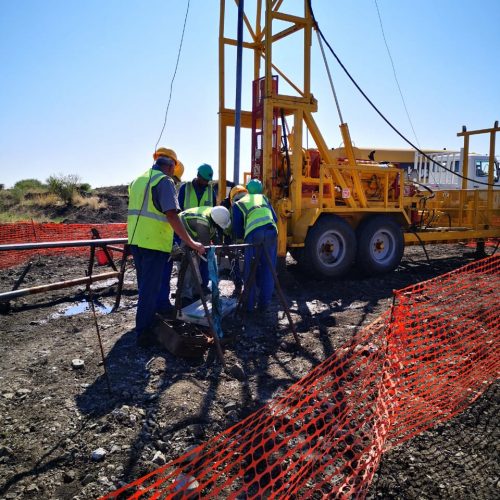
STANDARD OPERATING PROCEDURE: DRILLING BOREHOLES
- AIM
The aim of this document is to indicate the tasks related to drilling and to attach a risk ranking to each task. To provide the employees with clearinstructions on how to conduct drilling operations.
- Scope
The scope of this exercise is to identify all tasks that have to be executed during a drilling operation, to break these tasks into procedures and to evaluate all hazards related to these procedures. This procedure applies to all employees, visitors and suppliers of a surface drilling project.
- References
MHS Act 29, 1996
- Terms, definitions, tables and relevant formulas
a) A “hazard” is a source of, or exposure to danger. It is something that has the potential to cause injury to persons and or damage property
- Terms, definitions, tables and relevant formulas
b)“Risk” consists of both the probabilitythat an incident may occur as well as the severity of the occurrence. This severity indicates the effect on persons, equipment, production, work systems, the environment, quality, etc.
- Executive summary
The Hazard Analysis Technique was used to identify the hazards and assess the risks. It is believed that all the possible hazards related to Surface Drilling were identified.
The biggest hazards that exploration drilling faces are the following:
- Electrical Lines, either overhead or underground
- Incompetent/ inexperienced drill operators
- Unsafe Drill area (unstable soil/ mountainous or rocky surfaces cuttings etc.)
It is believed that the procedures and standards the company have established are adequate to ensure safe future operations.
LMC Drilling has an outstanding safety record and it would do any company proud to have LMC Drilling as their Surface Drilling Partner.
- Conclusion
This assessment will be evaluated annually to determine accuracy and efficiency.

Environmental management Plan
Objective: To ensure that all drivers and operators are aware of the dangers that can occur if mobile vehicle brake testing are not done and how to do it.
Contents:
1. Responsibilities
2. Storage
3. Decanting chemicals
4. Repairs involving petrochemical
5. Drainage systems, sumps and separators
6. Disposal of used oil and greases
7. Disposal of empty petrochemical containers, oil filters and oily rags
8. Cleaning up of spills and leaks
9. Reporting method
10. Testing new chemicals
11. Old oil handling
12. Pollution of water and streams
13. Treatment of graves